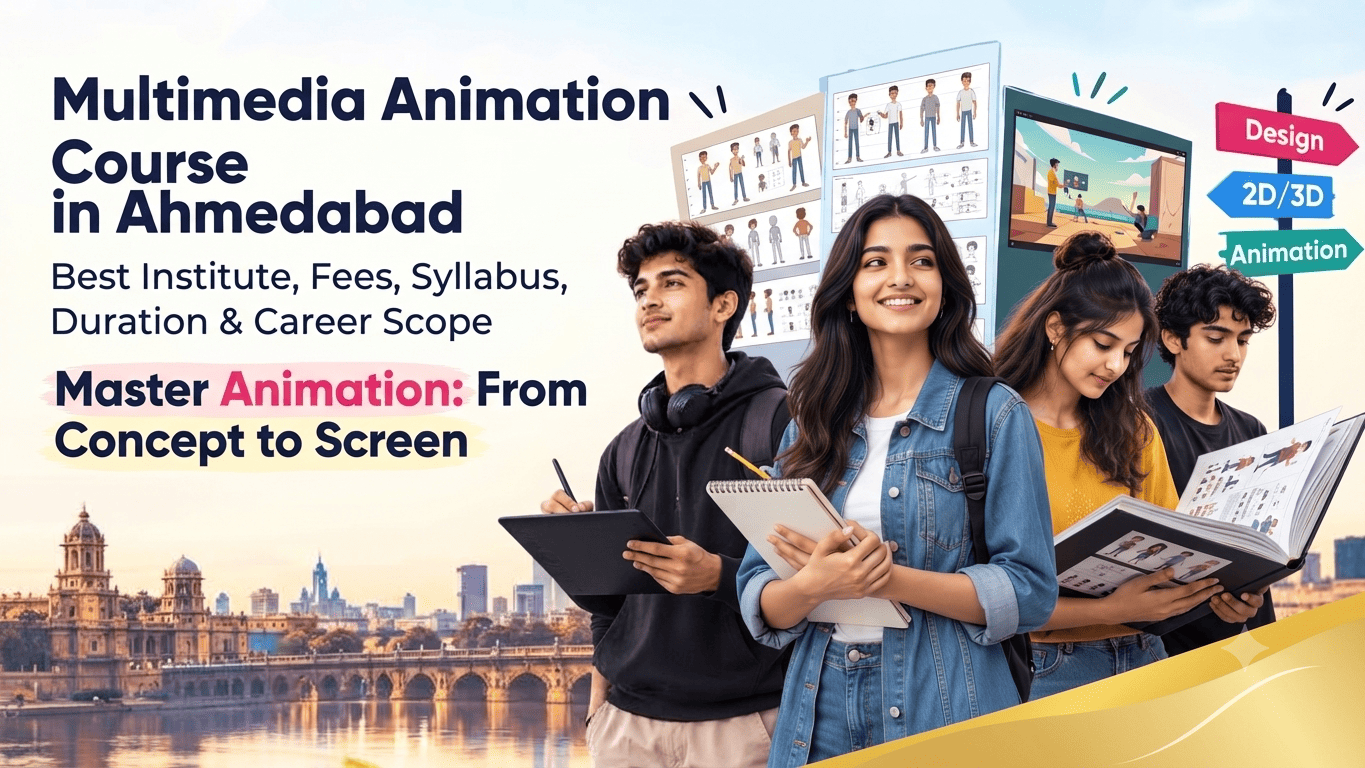
The animation and multimedia industry combines creativity, design, technology and storytelling to produce visual content for entertainment, advertising, gaming, education, digital media and businesses.
A Multimedia Animation Course in Ahmedabad can help students learn areas such as 2D animation, 3D animation, motion graphics, visual effects, graphic design, video editing, digital filmmaking and digital content production.
For students and beginners, choosing the right institute is important. A good course should provide a structured syllabus, practical projects, industry-relevant software training, portfolio development and guidance for entering the creative industry.
This guide explains the Multimedia Animation Course syllabus, fees, duration, eligibility, career opportunities, practical training and how to choose the best institute in Ahmedabad.
Introduction: What Is Multimedia Animation?
Multimedia animation combines different forms of digital media to communicate ideas through visuals and motion.
It can include:
- Animation
- Graphic design
- Video
- Audio
- Motion graphics
- Visual effects
- Illustration
- 2D and 3D content
- Digital filmmaking
- Interactive media
Animation is used in many industries today, including:
- Films
- Television
- Advertising
- Gaming
- Digital marketing
- Education
- E-learning
- YouTube
- Social media
- Product marketing
- Corporate communication
This makes multimedia and animation skills relevant to both traditional media and modern digital content.
Why Choose a Multimedia Animation Course in Ahmedabad?
Ahmedabad has a growing ecosystem of education, advertising, digital marketing, creative businesses, startups and media-related activities.
Multimedia skills can be useful for businesses that need:
- Promotional videos
- Social media content
- Brand graphics
- Motion graphics
- Product videos
- Advertisements
- Explainer videos
- Digital presentations
Students who learn animation and multimedia can therefore explore opportunities across different creative fields rather than limiting themselves to a single industry.
What Do You Learn in a Multimedia Animation Course?
The exact syllabus depends on the institute and course level, but a comprehensive program may include:
- Design fundamentals
- Drawing and visualisation
- Graphic design
- 2D animation
- 3D animation
- Motion graphics
- Video editing
- Visual effects
- Digital filmmaking
- Sound and audio
- AI-assisted creative workflows
- Portfolio development
The best course for a learner depends on their preferred career direction.
Multimedia Animation Course Syllabus
1. Design Fundamentals
Before learning animation, students need a basic understanding of design.
Topics may include:
- Composition
- Colour theory
- Typography
- Layout
- Visual hierarchy
- Balance
- Contrast
- Design principles
These fundamentals help students create better visual content.
2. Drawing & Visualisation
Drawing can help students understand visual form and movement.
Training may include:
- Basic drawing
- Shapes
- Proportions
- Perspective
- Character concepts
- Visual observation
- Storyboarding
Advanced animation programs may go deeper into character drawing and visual development.
3. Graphic Design
Graphic design is often an important part of multimedia training.
Students may learn:
- Logo design
- Branding
- Posters
- Brochures
- Social media creatives
- Digital advertisements
- Image editing
- Typography
- Layout design
These skills can also be useful for digital marketing and content creation.
4. 2D Animation
2D animation focuses on creating movement in a two-dimensional environment.
Students may learn:
- Animation principles
- Character animation
- Object animation
- Frame-by-frame animation
- Keyframes
- Timing
- Spacing
- Storyboarding
- Scene development
2D animation can be used in advertisements, educational content, entertainment and explainer videos.
5. 3D Animation
3D animation involves creating and animating objects or characters in a three-dimensional environment.
Topics may include:
- 3D modelling
- Texturing
- Lighting
- Rigging
- Character setup
- Animation
- Rendering
- Scene creation
3D skills can be applied to films, games, advertising, product visualisation and other digital content.
6. Motion Graphics
Motion graphics combine graphic design with animation.
Students may learn to create:
- Animated text
- Logo animations
- Promotional graphics
- Infographics
- Social media animations
- Title sequences
- Advertisement graphics
Motion graphics can be particularly useful for digital marketing and advertising.
7. Video Editing
Video editing is another important multimedia skill.
Students may learn:
- Timeline editing
- Cutting and trimming
- Transitions
- Audio synchronisation
- Colour correction
- Titles
- Captions
- Visual effects
- Video export
Projects may include:
- Reels
- YouTube videos
- Advertisements
- Short films
- Promotional videos
8. Visual Effects (VFX)
VFX allows creators to combine real footage with digitally created or modified elements.
Depending on the course, students may learn:
- Green-screen techniques
- Compositing
- Masking
- Tracking
- Background replacement
- Visual effects
- Scene enhancement
Advanced VFX training may require specialised software and additional practice.
9. Digital Filmmaking
Some multimedia programs also include filmmaking fundamentals.
Topics can include:
- Storytelling
- Scriptwriting
- Cinematography
- Camera basics
- Lighting
- Shot composition
- Production planning
- Video production
- Post-production
This combination can be useful for students interested in digital content and film production.
10. Audio & Sound
Multimedia content is not only visual.
Students may learn:
- Voiceovers
- Background music
- Sound effects
- Dialogue
- Audio editing
- Basic mixing
- Audio synchronisation
Good sound can significantly improve the quality of multimedia projects.
11. AI in Multimedia & Animation
Artificial Intelligence is becoming part of modern creative workflows.
Depending on the curriculum, students may explore AI-assisted applications such as:
- Creative ideation
- Image generation
- Concept development
- Storyboarding
- Video generation
- Background creation
- Voice generation
- Content creation
- Editing assistance
AI should complement fundamental creative skills rather than replace them.
Multimedia Animation Course Syllabus – Quick Overview
| Module | Key Skills |
|---|---|
| Design Fundamentals | Colour, typography, composition |
| Drawing | Visualisation and perspective |
| Graphic Design | Branding and digital graphics |
| 2D Animation | Character and object animation |
| 3D Animation | Modelling, lighting and animation |
| Motion Graphics | Animated graphics and typography |
| Video Editing | Editing, audio and colour |
| VFX | Compositing and visual effects |
| Filmmaking | Storytelling and production |
| Sound | Voice, music and effects |
| AI | AI-assisted creative workflows |
| Portfolio | Practical industry-style projects |
Multimedia Animation Course Duration in Ahmedabad
Course duration depends on the institute, curriculum and level of training.
Short-Term Courses
These are suitable for learners who want to develop specific skills such as:
- Video editing
- Motion graphics
- 2D animation
- Graphic design
Certificate Courses
These generally cover multiple multimedia skills and practical projects.
Advanced Programs
These may combine:
- Graphic design
- 2D animation
- 3D animation
- VFX
- Motion graphics
- Video editing
- Digital filmmaking
When comparing courses, don’t focus only on the number of months. Check the actual training hours, practical projects and syllabus depth.
Multimedia Animation Course Fees in Ahmedabad
Fees can vary significantly between institutes.
Factors that can influence course fees include:
- Course duration
- Number of modules
- Software training
- Practical sessions
- Trainer experience
- Classroom or online format
- Projects
- Certification
- Portfolio support
- Career guidance
There is no single fee applicable to every Multimedia Animation Course in Ahmedabad.
Students should ask the institute for the current fee structure, payment options and included services before enrolling.
A better comparison is:
Fee + Training Hours + Software + Projects + Portfolio + Career Support
rather than fee alone.
Who Can Join a Multimedia Animation Course?
A multimedia animation course can be suitable for:
- Students after 10th
- Students after 12th
- College students
- Graduates
- Beginners
- Aspiring animators
- Graphic designers
- Video editors
- Content creators
- Digital marketers
- Freelancers
- Working professionals
Creative interest and willingness to practise are often more important for beginners than having previous professional experience.
Multimedia Animation Course After 12th
Students can start learning multimedia and animation after completing 12th.
A possible career path is:
12th → Multimedia Animation Course → Practical Projects → Portfolio → Internship → Job/Freelancing
Students can choose a specialisation based on their interests.
If You Like Drawing
Consider:
2D Animation + Illustration + Character Design
If You Like Technology & 3D
Consider:
3D Animation + Modelling + VFX
If You Like Video
Consider:
Video Editing + Motion Graphics + Filmmaking
If You Like Digital Marketing
Consider:
Graphic Design + Motion Graphics + Digital Marketing
If You Like AI
Consider:
Generative AI + Design + Animation + Video
Career Opportunities After a Multimedia Animation Course
After developing practical skills, learners can explore roles such as:
- 2D Animator
- 3D Animator
- Multimedia Designer
- Graphic Designer
- Motion Graphics Designer
- Video Editor
- VFX Artist
- 3D Modelling Artist
- Visual Designer
- Character Designer
- Storyboard Artist
- Digital Content Creator
- Multimedia Artist
- Video Production Executive
The exact job title and requirements depend on the employer, specialisation and portfolio.
Industries That Hire Multimedia & Animation Professionals
Multimedia skills can be applied across several industries.
Animation & Production Studios
Creating animated content, characters and visual assets.
Advertising Agencies
Producing advertisements, motion graphics and branded content.
Digital Marketing Agencies
Creating social media graphics, videos and promotional content.
Gaming Industry
Working on:
- 3D assets
- Characters
- Environments
- Animation
- Visual effects
E-Learning Companies
Creating:
- Educational animations
- Explainer videos
- Interactive learning content
Corporate Companies
Developing:
- Presentations
- Training videos
- Promotional content
- Internal communication materials
Media & Entertainment
Creating video, animation and post-production content.
Freelancing After a Multimedia Animation Course
Multimedia skills can also be developed into freelance services.
Freelancers can offer:
- Logo animation
- Social media graphics
- Video editing
- Motion graphics
- Explainer videos
- 2D animation
- 3D modelling
- Product visualisation
- YouTube content
- Advertisement videos
- VFX services
A successful freelancer needs more than software knowledge.
Important skills include:
- Client communication
- Understanding briefs
- Time management
- Project management
- Pricing
- Revisions
- Portfolio presentation
How to Build a Multimedia Animation Portfolio
A portfolio is one of the most important parts of a creative career.
Beginners can create self-initiated projects.
Project 1 – Logo Animation
Create an animated logo for an imaginary brand.
Project 2 – Social Media Motion Graphic
Create a short promotional animation.
Project 3 – 2D Character Animation
Create a short character movement sequence.
Project 4 – 3D Product Animation
Create a simple 3D product visualisation.
Project 5 – Short Video
Combine:
Video + Graphics + Motion + Sound
Project 6 – VFX Project
Create a before-and-after visual-effects demonstration.
A strong portfolio should show different skills and creative problem-solving, not just software screenshots.
How to Choose the Best Multimedia Animation Institute in Ahmedabad
Before joining an institute, consider these factors.
1. Check the Complete Syllabus
Make sure the course covers the skills you want to develop.
2. Look for Practical Training
Ask how many projects students complete.
3. Check Software Training
Confirm which software is taught and whether it matches your career goal.
4. Review Student Portfolios
If available, examine previous student work.
5. Check Trainer Experience
Practical industry experience can be valuable.
6. Ask About Portfolio Development
Find out whether students receive guidance for building a professional portfolio.
7. Check Certification
Understand who issues the certificate and what it represents.
8. Understand Career Support
If an institute provides job assistance, ask what it actually includes. Job assistance should not automatically be understood as a guaranteed job.
9. Compare Classroom and Online Learning
Choose the format that fits your schedule and learning preferences.
10. Check Whether the Curriculum Is Updated
Animation, multimedia and AI tools change over time. An updated curriculum can help learners stay relevant.
Online vs Classroom Multimedia Animation Course
| Feature | Online | Classroom |
|---|---|---|
| Flexibility | High | Moderate |
| Travel | Not required | Required |
| Trainer interaction | Online | Face-to-face |
| Practical support | Depends on course | Direct |
| Schedule | Flexible | Fixed |
| Peer interaction | Varies | Usually higher |
| Suitable for working professionals | Often suitable | Depends on timing |
Both formats can work if the course provides structured learning and practical assignments.
Multimedia Animation + AI: A Modern Creative Skill Set
AI is changing parts of the creative production process.
AI can assist with:
- Concept generation
- Image creation
- Storyboarding
- Character concepts
- Video generation
- Voiceovers
- Background creation
- Content ideation
- Creative experimentation
However, AI tools alone do not create a complete creative professional.
A stronger skill combination is:
Design Fundamentals + Animation + Video + Storytelling + AI
This allows creators to use AI as part of a larger creative workflow.
Multimedia Animation vs Graphic Design
Students sometimes find it difficult to choose between graphic design and multimedia animation.
| Graphic Design | Multimedia Animation |
|---|---|
| Focuses mainly on static visual communication | Combines visual design with movement and media |
| Logos | Animation |
| Branding | 2D/3D content |
| Posters | Motion graphics |
| Social media graphics | Video |
| Typography | VFX |
| Layout | Digital filmmaking |
If you enjoy static visual design, graphic design may be a good starting point.
If you enjoy movement, video, storytelling and visual effects, multimedia animation may be a better fit.
Multimedia Animation Career Roadmap
A beginner can follow this learning path:
Step 1 – Learn Design Fundamentals
Understand colour, typography, composition and visual hierarchy.
Step 2 – Learn Graphic Design
Practise creating digital visuals and branding.
Step 3 – Choose a Specialisation
Select:
- 2D Animation
- 3D Animation
- Motion Graphics
- VFX
- Video Editing
- Digital Filmmaking
Step 4 – Learn Relevant Software
Develop practical skills with tools used in your chosen area.
Step 5 – Add AI Skills
Learn AI-assisted workflows that support creative production.
Step 6 – Build Projects
Create multiple practical projects.
Step 7 – Build Your Portfolio
Present your strongest work professionally.
Step 8 – Start Your Career
Explore:
Internship → Job → Freelancing → Specialisation
Quick Answer: Which Multimedia Course Should You Choose?
| Your Interest | Recommended Path |
|---|---|
| Drawing & Characters | 2D Animation |
| 3D & Technology | 3D Animation |
| Video | Video Editing + Filmmaking |
| Visual Effects | VFX + 3D |
| Advertising | Motion Graphics + Video |
| Branding | Graphic Design + Motion |
| Social Media | Graphic Design + Video + Motion |
| AI Creativity | Generative AI + Design + Animation |
| Gaming | 3D Modelling + Animation |
| Complete Creative Career | Multimedia + Animation + Video |
Frequently Asked Questions (FAQs)
1. What is a Multimedia Animation Course?
A Multimedia Animation Course teaches students how to create digital visual content using graphic design, animation, video, motion graphics, VFX and other multimedia techniques.
2. Which is the best Multimedia Animation Institute in Ahmedabad?
The best institute depends on your career goals. Look for an institute offering an updated syllabus, practical projects, relevant software, experienced trainers and portfolio development.
3. Can I join a Multimedia Animation Course after 12th?
Yes. Students can start multimedia and animation courses after 12th and gradually specialise in areas such as 2D animation, 3D animation, VFX, video editing or motion graphics.
4. What is included in a Multimedia Animation syllabus?
A comprehensive syllabus may include design fundamentals, graphic design, drawing, 2D animation, 3D animation, motion graphics, video editing, VFX, filmmaking, audio and AI-assisted creative workflows.
5. How much does a Multimedia Animation Course cost in Ahmedabad?
Fees vary depending on the institute, duration, software, practical training, projects, certification and career support. Students should check the latest fee structure directly with the institute.
6. How long is a Multimedia Animation Course?
Course duration varies from short-term skill programs to comprehensive advanced programs. The actual training hours and practical projects are more important than duration alone.
7. Can I get a job after an Animation Course?
A course can help develop relevant skills, but employment depends on your specialisation, portfolio, practical ability, communication skills, experience and employer requirements.
8. Can I freelance after learning animation?
Yes. Freelancers can offer services such as animation, motion graphics, video editing, VFX, graphic design and digital content production.
9. Is animation a good career for creative students?
Animation can be a suitable career for students who enjoy storytelling, drawing, design, technology, video and visual communication.
10. Should I learn AI along with animation?
AI can be a useful additional skill for modern creative professionals. However, it is best learned alongside core skills such as design, animation, storytelling, editing and visual communication.
Conclusion
A Multimedia Animation Course in Ahmedabad can help students and aspiring creative professionals build skills across graphic design, 2D and 3D animation, motion graphics, video editing, VFX, digital filmmaking and modern AI-assisted creative workflows.
When choosing the best institute, don’t focus only on the course name or advertised fee. Compare the syllabus, practical training, software, project work, trainer experience, portfolio development, certification and career support.
For students after 12th, a structured path can be:
Design Fundamentals → Graphic Design → Animation → Video/Motion/VFX Specialisation → AI Skills → Projects → Portfolio → Career
With consistent practice and a strong portfolio, multimedia and animation skills can open opportunities across animation studios, advertising agencies, digital marketing companies, gaming, e-learning, media, entertainment, corporate businesses and freelance work.