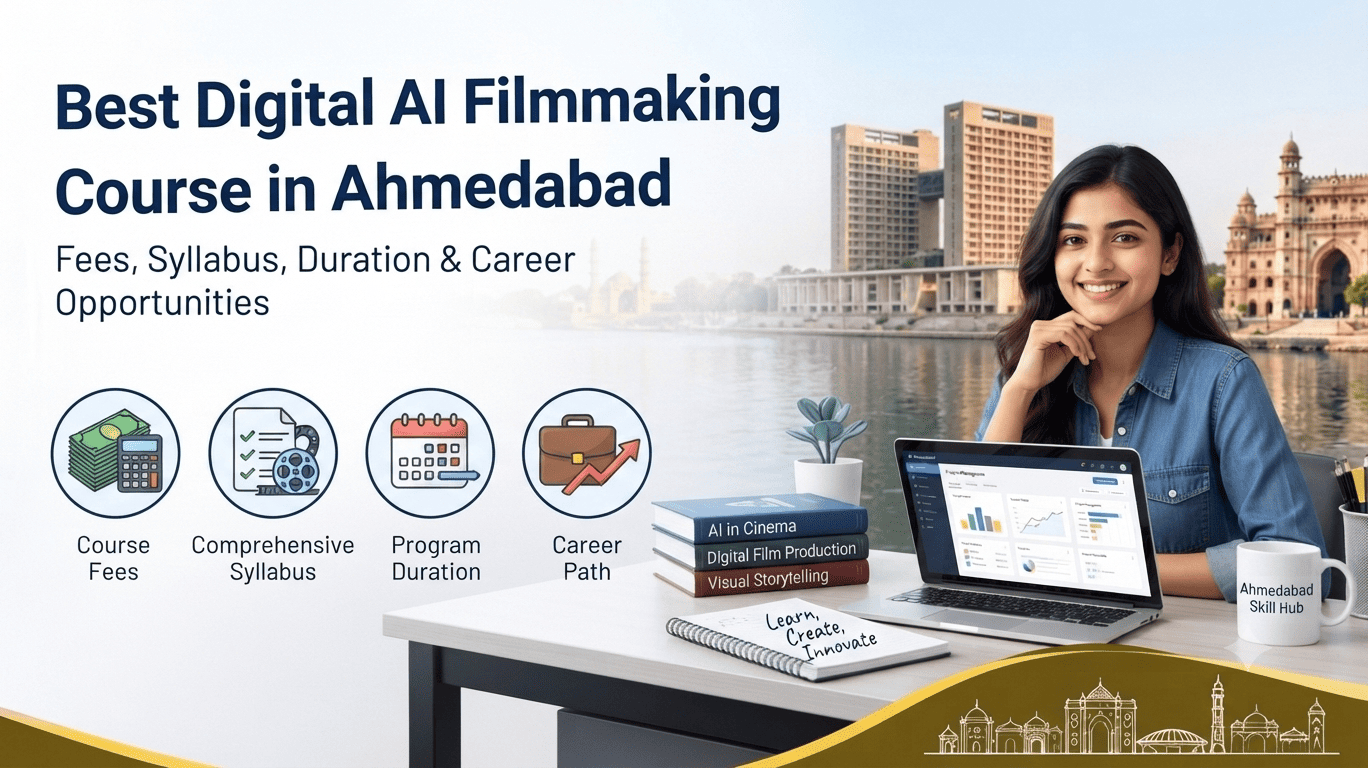
The filmmaking industry is changing rapidly with the introduction of Artificial Intelligence. From developing story ideas and scripts to creating visual concepts, generating scenes, editing videos, producing voiceovers and creating promotional content, AI can support several stages of modern video production.
A Digital AI Filmmaking Course in Ahmedabad combines traditional filmmaking and digital video-production skills with modern AI-assisted tools and workflows.
For students and aspiring creators, such a course can provide exposure to storytelling, scriptwriting, cinematography, video editing, visual effects, sound, AI video generation, AI-assisted post-production and content creation.
The right course should not focus only on AI tools. It should also teach filmmaking fundamentals and help learners create practical projects and a portfolio.
Introduction: What Is Digital AI Filmmaking?
Filmmaking has traditionally involved several stages, including:
Idea → Script → Pre-production → Production → Editing → Sound → Visual Effects → Distribution
Artificial Intelligence is now becoming useful across many of these stages.
AI can assist filmmakers with:
- Story ideas
- Script development
- Character concepts
- Storyboards
- Shot planning
- Visual references
- Image generation
- Video generation
- Voice and audio production
- Subtitles
- Video editing
- Background modification
- Content repurposing
A Digital AI Filmmaking Course in Ahmedabad aims to teach learners how to combine creative filmmaking knowledge with these emerging technologies.
Why Choose a Digital AI Filmmaking Course in Ahmedabad?
Ahmedabad has a growing creative, advertising, digital media, education and business ecosystem.
Video content is widely used by:
- Digital marketing agencies
- Advertising companies
- Social media teams
- Businesses
- Startups
- YouTube creators
- Production teams
- Educational organisations
- Personal brands
This creates opportunities for people with practical video-production and digital-content skills.
Learning filmmaking with AI can also help beginners explore multiple creative career paths instead of limiting themselves to traditional film production.
What Do You Learn in a Digital AI Filmmaking Course?
The syllabus can vary between institutes, but a comprehensive course may combine filmmaking fundamentals, digital production and AI-assisted workflows.
1. Introduction to Filmmaking
Students begin by understanding the basic filmmaking process.
Topics may include:
- Types of films and videos
- Visual storytelling
- Film language
- Production workflow
- Pre-production
- Production
- Post-production
- Distribution
Understanding the complete workflow is important before depending heavily on AI tools.
2. Storytelling & Concept Development
A strong film starts with a strong idea.
Students may learn:
- Idea generation
- Story structure
- Character development
- Story arcs
- Scene development
- Visual storytelling
- Concept creation
- Creative research
AI can be used as a brainstorming assistant, but the filmmaker remains responsible for creative decisions.
3. Scriptwriting
Scriptwriting is an important part of filmmaking.
A course may cover:
- Screenplay structure
- Scene descriptions
- Dialogue
- Character development
- Story pacing
- Short-form scripts
- Advertisement scripts
- Video scripts
- AI-assisted script ideation
Students can practise converting an idea into a structured script.
4. Storyboarding & Shot Planning
Before shooting or generating a scene, filmmakers need to understand how it will look.
Students may learn:
- Shot types
- Camera angles
- Framing
- Scene composition
- Shot lists
- Storyboards
- Visual references
- AI-assisted concept visualisation
AI can help create visual references for communicating creative ideas during pre-production.
5. Cinematography Fundamentals
AI does not eliminate the importance of understanding visual language.
A digital filmmaking course may introduce:
- Camera basics
- Composition
- Lighting
- Framing
- Camera movement
- Lens concepts
- Perspective
- Colour
- Visual continuity
These fundamentals help creators make better creative decisions even when using AI-generated content.
6. AI Image Generation for Filmmaking
Generative AI can be used to develop visual concepts.
Students may explore:
- Character concepts
- Environment concepts
- Location references
- Props
- Mood boards
- Scene concepts
- Promotional visuals
The exact tools taught can change as AI technology evolves, so learners should focus on transferable prompting and visual-direction skills rather than memorising one platform.
7. AI Video Generation
AI video generation is one of the most rapidly developing areas of digital filmmaking.
Depending on the course, students may learn workflows for:
- Text-to-video
- Image-to-video
- Scene generation
- Visual experiments
- Motion concepts
- Short-form video
- Concept films
- Social media videos
AI video generation can be useful for experimentation, pre-visualisation and certain types of content production.
8. AI-Assisted Video Editing
Editing remains one of the most important filmmaking skills.
A course may cover:
- Video editing fundamentals
- Timeline editing
- Cuts and transitions
- Audio synchronisation
- Colour correction
- Subtitles
- Captions
- AI-assisted editing
- Background/object editing
- Short-form video editing
Students should learn traditional editing principles alongside AI-assisted features.
9. AI Voiceover & Audio
Sound plays a major role in storytelling.
Students may explore:
- Voiceover creation
- AI-assisted narration
- Audio cleanup
- Background music
- Sound effects
- Dialogue editing
- Audio synchronisation
- Subtitle generation
AI voice tools can speed up production, but creators should consider quality, consent, licensing and appropriate usage.
10. Visual Effects & AI-Assisted Post-Production
Modern creators can use digital tools to enhance video production.
Topics may include:
- Background removal
- Object removal
- Visual enhancement
- Scene modification
- Motion effects
- Compositing
- AI-assisted visual effects
- Creative post-production
The exact syllabus depends on the institute and software used.
11. Social Media Video Production
Modern filmmaking skills are not limited to movies.
Businesses and creators increasingly need:
- Instagram Reels
- YouTube videos
- YouTube Shorts
- Advertisements
- Product videos
- Promotional videos
- Educational videos
- Brand films
Therefore, a career-oriented AI filmmaking course can include vertical video and short-form content production.
Digital AI Filmmaking Course Syllabus – Quick Overview
| Module | Key Topics |
|---|---|
| Filmmaking Fundamentals | Storytelling and production workflow |
| Scriptwriting | Screenplay, scenes and dialogue |
| Pre-production | Concepts, planning and shot lists |
| Storyboarding | Visual planning and shot design |
| Cinematography | Camera, lighting and composition |
| AI Image Generation | Characters, locations and concepts |
| AI Video Generation | Text-to-video and image-to-video workflows |
| Video Editing | Editing, transitions and storytelling |
| AI Audio | Voiceover, audio cleanup and sound |
| VFX | Digital effects and compositing |
| Social Media Video | Reels, Shorts and promotional videos |
| Portfolio | Practical filmmaking projects |
Digital AI Filmmaking Course Duration in Ahmedabad
Course duration varies depending on the depth of the curriculum and training format.
Generally, courses can be structured as:
Short-Term Courses
Suitable for learners who want an introduction to AI filmmaking and digital video creation.
Certificate Courses
Usually provide broader training covering multiple filmmaking and AI applications.
Advanced Programs
May include deeper filmmaking, editing, VFX, motion graphics and AI workflows.
Instead of selecting a course only based on duration, compare:
- Number of practical sessions
- Projects
- Software training
- AI tools covered
- Trainer support
- Portfolio development
- Career guidance
A longer course is not automatically better if the curriculum is outdated or lacks practical work.
Digital AI Filmmaking Course Fees in Ahmedabad
The fee for a Digital AI Filmmaking Course can vary considerably between institutes.
Factors affecting fees include:
- Course duration
- Curriculum depth
- Classroom or online format
- Software training
- AI tools covered
- Practical projects
- Trainer experience
- Certification
- Portfolio support
- Career assistance
Because course fees change between institutes and batches, students should request the latest fee structure directly from the training institute.
When comparing fees, do not look only at the price. Compare the total learning value and practical exposure.
Who Can Join a Digital AI Filmmaking Course?
A Digital AI Filmmaking Course can be suitable for:
- Students after 10th or 12th
- College students
- Graduates
- Aspiring filmmakers
- Video editors
- Content creators
- YouTubers
- Social media professionals
- Digital marketers
- Graphic designers
- Freelancers
- Advertising professionals
- Working professionals interested in creative upskilling
You do not necessarily need to be an experienced filmmaker to start a beginner-level course.
Digital AI Filmmaking Course After 12th
Students who have completed 12th can explore filmmaking as a creative career.
A possible learning path is:
12th → Digital Filmmaking Fundamentals → Video Editing → AI Filmmaking → Portfolio → Internship/Job/Freelancing
Students interested in broader creative careers can also combine filmmaking with:
- Graphic Design
- Motion Graphics
- Animation
- UI/UX
- Digital Marketing
- Generative AI
This combination can provide a broader digital creative skill set.
Career Opportunities After Digital AI Filmmaking
After developing filmmaking, editing and AI-assisted production skills, learners can explore roles such as:
- Video Editor
- Content Creator
- Video Producer
- Digital Filmmaker
- Assistant Director
- Scriptwriter
- Creative Content Specialist
- Social Media Video Creator
- AI Video Creator
- Video Production Executive
- Motion Graphics Artist
- Post-Production Assistant
- YouTube Video Producer
Career opportunities depend on portfolio quality, practical skills, communication, experience and the requirements of individual employers.
Can You Freelance After Learning AI Filmmaking?
Yes.
AI-assisted filmmaking can be particularly useful for freelance digital-content services.
Possible freelance services include:
Social Media Videos
Create short-form videos for brands and creators.
YouTube Editing
Edit long-form videos and Shorts.
Promotional Videos
Create digital advertisements and brand videos.
AI Video Content
Develop AI-assisted creative video concepts.
Script & Story Development
Provide scriptwriting and creative development support.
Product Videos
Create promotional videos for businesses and products.
However, successful freelancing requires more than learning AI tools. You also need:
- Communication skills
- Editing skills
- Creative thinking
- Client management
- Portfolio
- Pricing knowledge
- Project management
Digital Filmmaking vs AI Filmmaking
A common question is whether students should learn traditional filmmaking or AI filmmaking.
The strongest approach is to understand both.
| Digital Filmmaking | AI Filmmaking |
|---|---|
| Traditional production concepts | AI-assisted production |
| Camera knowledge | AI-generated visuals |
| Cinematography | AI visualisation |
| Video editing | AI-assisted editing |
| Sound design | AI-assisted audio |
| Physical production | Digital generation workflows |
| Human creative direction | AI-supported experimentation |
AI should be viewed as an additional creative capability rather than a complete replacement for filmmaking knowledge.
Benefits of Learning Digital AI Filmmaking
1. Faster Creative Experimentation
AI can help creators test multiple ideas quickly.
2. More Visual Possibilities
Creators can experiment with scenes, characters and environments.
3. Useful for Social Media
AI filmmaking skills can support short-form content creation.
4. Broader Career Options
Learners can work across video, marketing, advertising and content creation.
5. Freelancing Opportunities
Creators can offer AI-assisted video services to clients.
6. Creative Upskilling
Existing designers, marketers and video editors can add AI to their current skill set.
How to Choose the Best Digital AI Filmmaking Course in Ahmedabad
Before enrolling, check the following:
1. Course Syllabus
Make sure the curriculum includes both filmmaking fundamentals and AI applications.
2. Practical Projects
Ask whether you will actually create videos and complete projects.
3. AI Tools
Check whether the course introduces current AI workflows and teaches concepts that remain useful as tools change.
4. Video Editing
Editing should be an important part of the course.
5. Portfolio Development
Choose a course that helps you build work that can be shown to employers or clients.
6. Trainer Experience
Check the instructor’s practical experience.
7. Certification
Understand what type of certificate is provided and who issues it.
8. Career Support
If an institute offers job assistance, ask what exactly is included. Job assistance should not automatically be interpreted as a guaranteed job.
9. Online or Classroom Format
Select a format that matches your schedule and preferred learning style.
What Software and AI Tools Can Be Used in AI Filmmaking?
The AI filmmaking ecosystem changes rapidly.
Depending on the course, learners may encounter tools for:
- AI writing
- Image generation
- Video generation
- Voice generation
- Audio enhancement
- Video editing
- Visual effects
- Caption generation
- Research
- Storyboarding
- Creative ideation
Traditional filmmaking and editing software may also be part of the curriculum.
The important thing is not simply learning a long list of tools. Students should learn how to combine tools into a complete production workflow.
Digital AI Filmmaking Career Roadmap
A beginner can follow this roadmap:
Step 1: Learn Storytelling
Understand how stories, scenes and visual communication work.
Step 2: Learn Filmmaking Fundamentals
Study composition, lighting, camera concepts and production.
Step 3: Learn Video Editing
Practise cutting, pacing, audio and visual storytelling.
Step 4: Learn Generative AI
Understand prompts, AI images and AI video generation.
Step 5: Build Practical Projects
Create short films, advertisements, social videos or concept videos.
Step 6: Create a Portfolio
Select your strongest projects and present them professionally.
Step 7: Choose a Career Direction
You can explore:
Job → Internship → Freelancing → Content Creation → Production
Quick Answer: Is Digital AI Filmmaking a Good Career Option?
Yes, it can be a promising creative career path for people interested in filmmaking, video production, content creation and digital media.
However, the strongest profile is not simply:
“I know AI video tools.”
A stronger profile is:
“I understand storytelling, filmmaking, editing and AI-assisted production.”
This combination can make your skills more versatile as digital video continues to grow.
Frequently Asked Questions
1. What is a Digital AI Filmmaking Course?
A Digital AI Filmmaking Course combines traditional filmmaking and digital video-production skills with Artificial Intelligence tools and workflows used for ideation, visualisation, video creation, editing, audio and post-production.
2. Is AI filmmaking suitable for beginners?
Yes. Beginner-level courses can introduce filmmaking fundamentals and AI tools step by step without requiring previous professional filmmaking experience.
3. Can I join an AI filmmaking course after 12th?
Yes. Students after 12th can learn digital filmmaking, video editing, Generative AI and AI-assisted content creation.
4. What is included in an AI filmmaking syllabus?
A comprehensive syllabus may include storytelling, scriptwriting, storyboarding, cinematography, video editing, AI image generation, AI video generation, audio, VFX, social media video and portfolio development.
5. How much does a Digital AI Filmmaking Course cost in Ahmedabad?
Fees vary depending on the institute, duration, curriculum, training format, software, practical projects and other services. Students should check the latest fee structure directly with the institute.
6. How long does an AI filmmaking course take?
The duration depends on the course level. Short-term programs may introduce the fundamentals, while comprehensive programs can provide deeper training in filmmaking, editing, VFX and AI workflows.
7. Do I need a camera to learn AI filmmaking?
Not necessarily. Beginners can start by learning storytelling, editing, AI visualisation and digital production workflows. A camera can become useful when learning practical cinematography and live-action production.
8. Can I get a job after an AI filmmaking course?
An AI filmmaking course can help develop relevant skills, but getting a job depends on your portfolio, practical ability, communication, experience and employer requirements.
9. Can I freelance after completing an AI filmmaking course?
Yes. You can explore freelance services such as video editing, social media videos, promotional videos, AI-assisted video production and content creation.
10. Is AI going to replace filmmakers?
AI is changing filmmaking workflows, but filmmaking still requires storytelling, creative direction, editing, visual judgement and human decision-making. Learning to work with AI can therefore be more useful than simply treating AI as a replacement for creative professionals.
Conclusion
A Digital AI Filmmaking Course in Ahmedabad can be an interesting option for students, aspiring filmmakers, video editors, content creators and working professionals who want to build modern digital-media skills.
The best course should combine storytelling, filmmaking fundamentals, cinematography, scriptwriting, video editing, AI image and video generation, audio, post-production and practical projects.
Instead of choosing a course only by its fee or the number of AI tools included, compare the syllabus, practical training, project work, portfolio development, trainer support and career guidance.
For beginners, a strong learning path is:
Filmmaking Fundamentals → Video Editing → Generative AI → AI Video Production → Practical Projects → Portfolio → Career/Freelancing
As AI continues to influence the creative industry, professionals who combine creative thinking with filmmaking and AI skills can be better prepared to adapt to new digital production workflows.