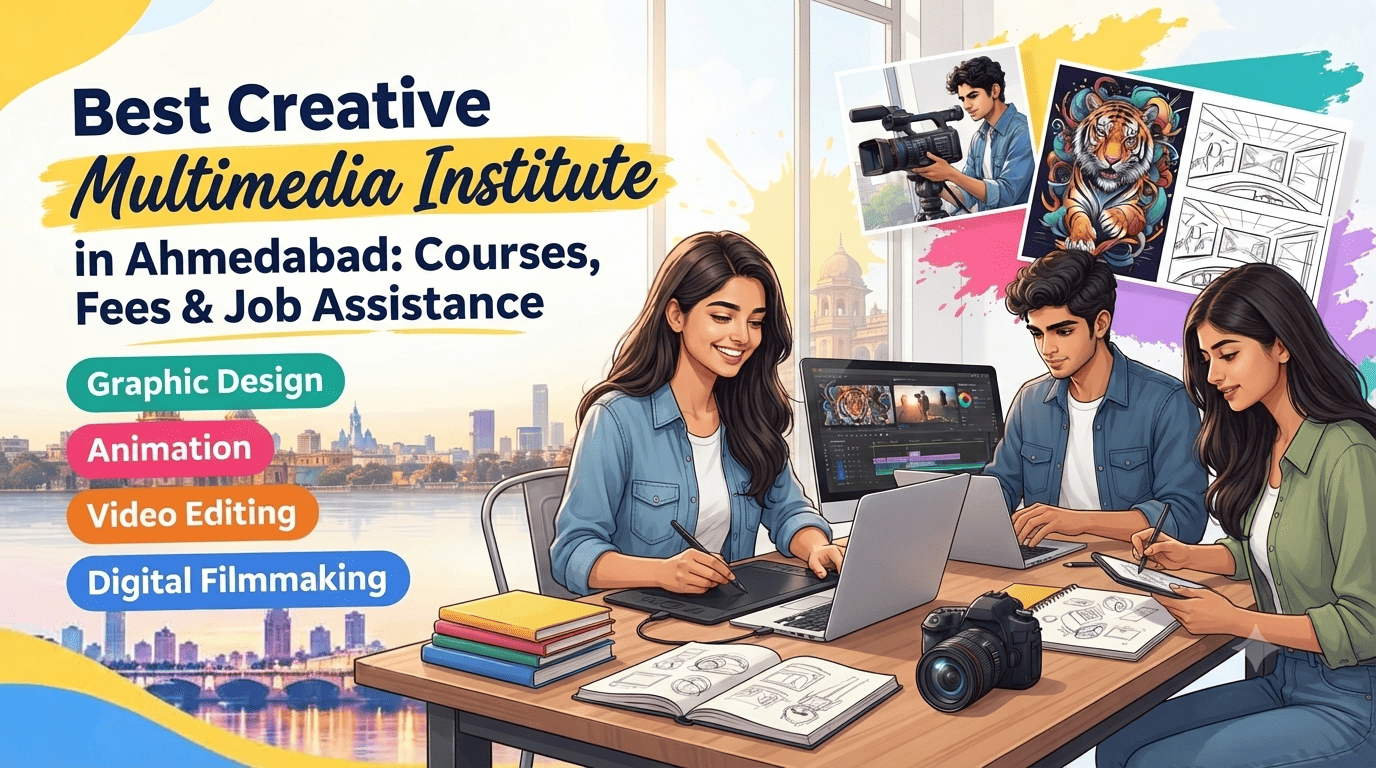
The creative industry has changed significantly with the growth of digital media, social platforms, advertising, video content, animation, design, and emerging technologies.
For students, graduates, and aspiring creative professionals in Ahmedabad, this has created multiple career opportunities in areas such as Graphic Design, Multimedia Animation, Video Editing, UI/UX Design, Motion Graphics, Digital Filmmaking, and digital content creation.
But with many institutes and courses available, one question often comes first:
How do you choose the best creative multimedia institute in Ahmedabad?
The answer should not depend only on advertisements, course fees, or promises of placement. A good institute should provide a combination of practical training, industry-relevant software, experienced guidance, portfolio development, projects, career preparation, and placement assistance.
This guide explains the courses you can consider, typical syllabus areas, fee factors, career opportunities, and what to check before joining a creative multimedia institute in Ahmedabad.
Quick Answer: What Makes a Good Multimedia Institute?
A good creative multimedia institute should ideally offer:
- Industry-relevant creative courses
- Practical, project-based learning
- Professional software training
- Experienced trainers
- Portfolio development
- Real-world assignments
- Updated curriculum
- Internship or industry exposure
- Resume and interview preparation
- Placement assistance
- Guidance for freelance opportunities
- Exposure to modern digital and AI-assisted workflows
The best institute for you depends on your career goal, preferred specialization, learning style, budget, and the quality of practical training available.
What Is a Creative Multimedia Institute?
A creative multimedia institute provides professional training in visual communication, digital media, design, animation, video, and related creative technologies.
Unlike a course that focuses on only one software application, a well-structured multimedia program may combine creative fundamentals + software skills + practical projects + portfolio development.
Depending on the institute, students may be able to choose from courses such as:
- Graphic Design
- Multimedia Animation
- Video Editing
- Motion Graphics
- UI/UX Design
- Digital Filmmaking
- 2D & 3D Animation
- Visual Effects
- Digital Content Creation
- Creative Design with modern AI-assisted workflows
Why Choose a Multimedia Course in Ahmedabad?
Ahmedabad has a growing ecosystem of businesses, startups, advertising agencies, digital marketing companies, educational organizations, media teams, production houses, e-commerce businesses, and other organizations that require creative digital content.
Businesses need professionals who can create:
- Social media creatives
- Brand identities
- Advertisements
- Promotional videos
- Website visuals
- Product videos
- Motion graphics
- Presentations
- Digital campaigns
- Marketing content
This makes creative and multimedia skills relevant across multiple industries.
For students, learning these skills can provide different career paths instead of limiting them to a single job role.
Popular Creative Multimedia Courses in Ahmedabad
1. Graphic Design Course
Graphic Design focuses on visual communication.
Students typically learn:
- Design fundamentals
- Typography
- Color theory
- Composition
- Layout design
- Logo design
- Branding
- Social media creatives
- Advertising design
- Print design
- Digital design
- Image editing
- Portfolio development
Career Options
After completing Graphic Design training, students can explore roles such as:
- Graphic Designer
- Visual Designer
- Brand Designer
- Social Media Designer
- Creative Designer
- Marketing Designer
- Junior Art Director
2. Multimedia Animation Course
Multimedia Animation combines design, movement, storytelling, and technology.
Depending on the specialization, the syllabus may include:
- Drawing fundamentals
- 2D animation
- 3D modelling
- Texturing
- Lighting
- Rendering
- Character design
- Motion graphics
- Visual effects
- Compositing
- Storyboarding
- Animation principles
Career Options
Students can explore roles such as:
- 2D Animator
- 3D Artist
- Motion Graphics Designer
- 3D Modeller
- Character Artist
- VFX Artist
- Compositor
- Multimedia Designer
3. Video Editing Course
Video Editing focuses on transforming raw footage into engaging visual stories.
A professional video editing syllabus may include:
- Editing fundamentals
- Timeline editing
- Video transitions
- Audio editing
- Color correction
- Color grading
- Titles and subtitles
- Motion graphics
- Short-form video editing
- YouTube video editing
- Promotional videos
- Advertisement editing
- Storytelling
Career Options
Possible roles include:
- Video Editor
- YouTube Video Editor
- Social Media Video Editor
- Reels Editor
- Post-Production Assistant
- Content Editor
- Corporate Video Editor
- Junior Video Producer
4. UI/UX Design Course
UI/UX combines creativity with user-centered digital product design.
Students may learn:
- User research
- User personas
- Information architecture
- Wireframing
- Prototyping
- User flows
- Interface design
- Responsive design
- Usability principles
- Design systems
- Portfolio projects
Career Options
Possible roles include:
- UI Designer
- UX Designer
- Product Designer
- UI/UX Designer
- Visual Designer
Students interested in websites and applications may find UI/UX an attractive specialization.
5. Digital Filmmaking Course
Digital filmmaking combines storytelling, cinematography, production, editing, sound, and post-production.
Depending on the course, students may learn:
- Story development
- Scriptwriting
- Storyboarding
- Camera basics
- Cinematography
- Lighting
- Direction
- Sound recording
- Video production
- Editing
- Color grading
- Post-production
Career Opportunities
Students can explore opportunities in:
- Video production
- Advertising
- Digital content
- Corporate filmmaking
- Social media production
- YouTube
- Production houses
- Freelance filmmaking
Creative Multimedia Course Syllabus
The exact syllabus differs between institutes, but a comprehensive multimedia curriculum can be divided into several stages.
Stage 1: Creative Fundamentals
Students learn the principles behind good visual communication.
Topics can include:
- Design principles
- Color
- Typography
- Composition
- Visual hierarchy
- Creativity
- Storytelling
Stage 2: Software Training
Students learn the professional tools relevant to their specialization.
For example:
Graphic Design: image editing, vector design, layout and prototyping tools.
Animation: 2D/3D animation, modelling, motion and compositing tools.
Video: professional editing, motion graphics, audio and color tools.
Stage 3: Practical Projects
Students apply their skills through projects such as:
- Brand identity
- Social media campaign
- Advertisement
- Short video
- Animated sequence
- Website/app interface
- Promotional video
Stage 4: Portfolio Development
Students organize their strongest projects into a professional portfolio.
A portfolio can be useful for:
- Job applications
- Interviews
- Freelancing
- Client presentations
- Internships
Stage 5: Career Preparation
Students can receive guidance on:
- Resume creation
- Portfolio presentation
- Interview preparation
- Communication skills
- Job applications
- Freelancing basics
Multimedia Course Fees in Ahmedabad
One of the first questions students ask is:
“How much does a multimedia course cost in Ahmedabad?”
There is no single fee applicable to every multimedia course.
Fees can vary significantly depending on:
- Course specialization
- Course duration
- Depth of curriculum
- Number of software applications taught
- Practical training
- Faculty experience
- Infrastructure
- Certification
- Internship opportunities
- Portfolio development
- Career support
Typical Fee Structure
Instead of focusing only on a fixed amount, students should compare the total value of the course.
For example:
Short-term course → suitable for learning a specific skill.
Professional course → broader curriculum with multiple software and projects.
Advanced/integrated program → deeper training across multiple creative disciplines.
Before enrolling, ask the institute for the latest fee structure, payment options, course duration, and exactly what is included.
Does a Higher Course Fee Mean Better Training?
Not necessarily.
A more expensive course does not automatically mean better education.
Students should compare:
- Curriculum
- Practical hours
- Faculty
- Projects
- Portfolio support
- Software training
- Infrastructure
- Internship opportunities
- Career services
- Student work
Quality of training matters more than the price alone.
What Does 100% Job Assistance Mean?
Many institutes advertise “100% Job Assistance.”
Students should understand an important distinction:
Job Assistance ≠ Guaranteed Job
Job assistance can include services such as:
- Resume preparation
- Portfolio guidance
- Interview preparation
- Career counselling
- Job-opening information
- Interview opportunities
- Employer connections
- Placement coordination
- Communication and professional-skills guidance
However, students should ask the institute exactly what its 100% job assistance program includes.
A job outcome can depend on factors such as:
- Student skills
- Portfolio quality
- Interview performance
- Communication
- Attendance
- Experience
- Employer requirements
- Available openings
Therefore, always ask for clear details rather than assuming that “100% job assistance” means a guaranteed job.
How to Choose the Best Creative Multimedia Institute in Ahmedabad
Before enrolling, use this checklist.
1. Check the Curriculum
Does the syllabus match your career goal?
A good curriculum should balance fundamentals and practical skills.
2. Check the Software Training
Find out which professional tools are included.
Don’t choose an institute only because it lists many software names. Make sure you will actually learn to use them through practical assignments.
3. Ask About Practical Projects
Ask:
“How many projects will I complete during the course?”
Practical work is essential in creative careers.
4. Review Student Portfolios
Ask to see actual student projects.
This can help you understand the quality and depth of training.
5. Meet the Trainers
If possible, interact with trainers before enrolling.
Ask about their experience and teaching approach.
6. Check Portfolio Support
A certificate is useful, but a strong portfolio can demonstrate your actual abilities.
7. Ask About Internship Opportunities
Practical industry exposure can help students understand professional workflows.
8. Understand Placement Assistance
Ask exactly how the placement process works.
Questions to ask include:
- How are job opportunities shared?
- Are interviews arranged?
- Is resume support provided?
- Is interview preparation included?
- Which types of companies recruit students?
- Is placement assistance available after course completion?
9. Compare Course Duration
A very short course may teach only fundamentals, while a longer program may offer deeper specialization.
Choose according to your career objective.
10. Check the Learning Environment
Look at:
- Classrooms
- Systems
- Software
- Practical facilities
- Batch size
- Trainer availability
Which Creative Course Is Best for You?
Choosing the right course becomes easier when you start with your interests.
| Your Interest | Recommended Course |
|---|---|
| Logos, branding and visual design | Graphic Design |
| Social media creatives | Graphic Design |
| Animation and characters | Multimedia Animation |
| 2D/3D visuals | Animation |
| Motion graphics | Animation / Motion Graphics |
| YouTube and Reels | Video Editing |
| Films and storytelling | Video Editing / Filmmaking |
| Websites and apps | UI/UX Design |
| Digital content | Graphic Design / Video Editing |
| Multiple creative fields | Integrated Multimedia Course |
Which Creative Course Is Best After 12th?
Students can consider different creative courses after completing 12th.
If you enjoy drawing and visual design:
Consider Graphic Design.
If you enjoy animation and 3D:
Consider Multimedia Animation.
If you enjoy videos and storytelling:
Consider Video Editing or Digital Filmmaking.
If you enjoy websites and apps:
Consider UI/UX Design.
If you are unsure:
An integrated multimedia program that introduces several creative disciplines can help you understand different career paths before choosing a specialization.
Can Multimedia Skills Be Used for Freelancing?
Yes.
Creative professionals can offer freelance services depending on their specialization.
Graphic Design Freelancing
- Logo design
- Social media design
- Branding
- Posters
- Marketing materials
Video Editing Freelancing
- YouTube videos
- Reels
- Promotional videos
- Corporate videos
- Short-form content
Animation Freelancing
- Motion graphics
- Animated advertisements
- Explainer videos
- 2D animation
- 3D assets
UI/UX Freelancing
- Website interfaces
- Mobile app interfaces
- Wireframes
- Prototypes
- Design systems
Freelancing requires more than technical skills. You also need communication, portfolio development, client management, pricing knowledge, and professional discipline.
Role of AI in Creative Multimedia Careers
Modern creative professionals are increasingly exposed to AI-assisted workflows.
AI can support creative professionals with tasks such as:
- Idea generation
- Content brainstorming
- Image enhancement
- Background removal
- Transcription
- Caption creation
- Concept development
- Workflow automation
- Content variations
However, students should not rely entirely on automated tools.
Strong fundamentals in:
Design + Creativity + Storytelling + Editing + Communication + Human judgment
remain important.
A future-ready creative course should ideally teach students how to use modern technology alongside core creative skills.
Career Scope After a Multimedia Course
A multimedia education can open multiple career directions.
Depending on specialization, students may work in:
- Advertising agencies
- Digital marketing agencies
- Design studios
- Production houses
- Animation studios
- Media companies
- E-commerce companies
- Startups
- Corporate marketing teams
- Education companies
- Gaming-related creative teams
- Freelance businesses
Possible job roles include:
Graphic Designer → Senior Designer → Art Director
Video Editor → Senior Editor → Video/Creative Lead
Animator → Senior Animator → Animation/Motion Lead
UI Designer → UI/UX Designer → Product Designer
Career progression depends on skills, experience, portfolio quality, specialization, and professional development.
Skills That Can Improve Your Creative Career
Completing a course is only the beginning.
Students should develop:
Creativity
Learn to generate original ideas and communicate them visually.
Communication
Understand how to explain ideas to clients, teammates, and employers.
Problem-Solving
Design is often about solving a communication or business problem.
Portfolio Building
Keep improving and updating your best projects.
Time Management
Creative professionals often work with deadlines.
Adaptability
Software, platforms, and creative workflows continuously change.
AI Awareness
Understand how modern AI-assisted workflows can complement your creative skills.
A Practical Roadmap to Start a Creative Career
Step 1: Identify Your Interest
Ask yourself:
Do I prefer design, animation, video, filmmaking, or digital interfaces?
Step 2: Select Your Course
Choose a course aligned with your preferred career.
Step 3: Learn Fundamentals
Don’t skip design, storytelling, composition, color, typography, or editing fundamentals.
Step 4: Learn Professional Software
Build confidence with the tools used in your chosen field.
Step 5: Complete Practical Projects
Create real-world projects rather than only classroom exercises.
Step 6: Build a Portfolio
Select your strongest work and present it professionally.
Step 7: Gain Practical Experience
Consider internships, freelance assignments, personal projects, or industry exposure.
Step 8: Prepare for Jobs
Work on your:
- Resume
- Portfolio
- Interview skills
- Communication
- Professional profile
Step 9: Keep Learning
Creative technology changes quickly, so continuous learning is essential.
Why Portfolio Matters More Than Just a Certificate
A certificate shows that you completed a course.
A portfolio demonstrates what you can actually create.
For example, instead of simply writing:
“Graphic Design Course Completed”
a portfolio can show:
- Brand identity
- Logo projects
- Social media campaigns
- Posters
- Advertisements
- Packaging concepts
Similarly, a video editor can show:
- Reels
- YouTube edits
- Promotional videos
- Color-grading samples
- Motion graphics
Employers and clients can use this work to understand your practical abilities.
Frequently Asked Questions
1. Which is the best creative multimedia institute in Ahmedabad?
The best institute depends on your preferred specialization, budget, career goals, curriculum, practical training, trainers, portfolio development, and placement support. Compare these factors before enrolling.
2. What courses are available at a multimedia institute?
Common options include Graphic Design, Multimedia Animation, Video Editing, Motion Graphics, UI/UX Design, Digital Filmmaking, 2D/3D Animation, and other creative digital-media programs.
3. What is the fee for a multimedia course in Ahmedabad?
Fees vary according to the course, duration, specialization, curriculum, facilities, and institute. Students should request the latest fee structure directly from the institute before admission.
4. Is there a multimedia course after 12th?
Yes. Students who have completed 12th can explore Graphic Design, Animation, Video Editing, UI/UX, Digital Filmmaking, and other multimedia programs depending on their interests.
5. Is Graphic Design a good career option?
Graphic Design can lead to opportunities in branding, advertising, social media, digital marketing, publishing, businesses, design studios, and freelance work.
6. Is Video Editing a good career in 2026?
Video is widely used for marketing, entertainment, education, social media, and online content. This creates opportunities for skilled video editors who can produce professional content for different platforms.
7. Is animation difficult to learn?
Animation can have a learning curve, especially in areas such as 3D modelling, rigging, rendering, and visual effects. Consistent practice and project-based training can help beginners progress.
8. Does 100% job assistance guarantee a job?
No. “Job assistance” and “job guarantee” are not necessarily the same. Students should ask the institute for the exact terms and services included in its placement program.
9. Can I freelance after completing a multimedia course?
Yes. Graphic designers, video editors, animators, UI/UX designers, and other creative professionals can offer freelance services after developing the required skills and portfolio.
10. Should I choose a short-term or long-term multimedia course?
A short-term course may be suitable for learning a specific skill, while a longer professional program may provide broader and deeper training. Your choice should depend on your career goal and available time.
11. Do multimedia courses include AI?
This depends on the institute and curriculum. Some modern programs include AI-assisted creative workflows, while others focus primarily on traditional creative software and techniques.
12. What should I check before joining a multimedia institute in Ahmedabad?
Check the syllabus, trainers, software, practical projects, student portfolios, course duration, fees, certification, internship opportunities, infrastructure, and placement assistance.
Conclusion
Choosing the best creative multimedia institute in Ahmedabad is an important decision for students who want to build a career in design, animation, video, UI/UX, filmmaking, or digital media.
Instead of choosing an institute only because of a promotional claim such as “100% Job Assistance,” look at the complete learning experience.
A strong creative education should combine:
Creative Fundamentals + Professional Software + Practical Projects + Portfolio Development + Industry Exposure + Career Guidance
Before enrolling, compare the course syllabus, fees, duration, trainers, practical training, student work, internship opportunities, and placement assistance.
Most importantly, choose a specialization that matches your interests.
If you enjoy design, explore Graphic Design.
If you love animation and visual effects, explore Multimedia Animation.
If you enjoy video and storytelling, consider Video Editing or Digital Filmmaking.
If you are interested in websites and applications, UI/UX Design may be the right direction.
And if you want to prepare for the changing creative industry, consider developing AI awareness alongside your core creative skills.
Your course can give you the foundation—but your practice, portfolio, creativity, and willingness to keep learning can shape your long-term career.