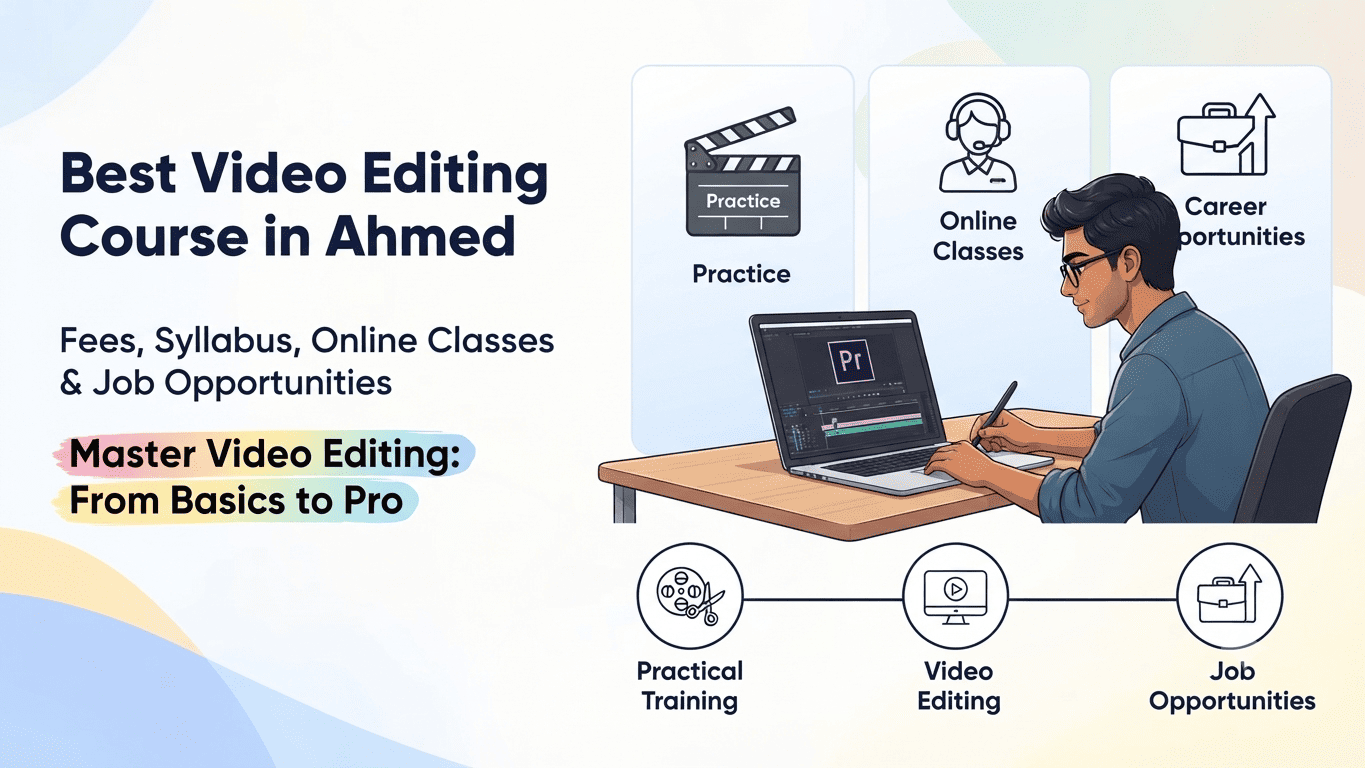
Video has become one of the most important forms of digital communication. Businesses, advertising agencies, content creators, YouTubers, educational companies and social media teams all use video to communicate with their audiences.
As demand for digital video continues to grow, video editing has become a practical creative skill for students, graduates, freelancers and working professionals.
A Video Editing Course in Ahmedabad can teach learners how to edit footage, create engaging stories, work with audio, add graphics and effects, perform colour correction and produce videos for different platforms.
The right course should combine software training, editing fundamentals, practical projects and portfolio development rather than focusing only on theoretical lessons.
Introduction: Why Learn Video Editing in Ahmedabad?
Video editing is no longer limited to films and television.
Today, video editors can work on:
- YouTube videos
- Instagram Reels
- YouTube Shorts
- Advertisements
- Corporate videos
- Product videos
- Educational videos
- Podcasts
- Events
- Social media campaigns
- Short films
- Digital content
Businesses increasingly use video for marketing, communication and brand building. This has created opportunities for people who can combine technical editing skills with creativity and storytelling.
For students in Ahmedabad, learning video editing can also provide a pathway into broader creative fields such as:
- Digital filmmaking
- Motion graphics
- Animation
- Visual effects
- Digital marketing
- Content creation
- AI-assisted video production
What Is a Video Editing Course?
A video editing course teaches learners how to transform raw footage into a finished video.
A typical editing workflow includes:
Import → Organise → Cut → Arrange → Add Audio → Add Graphics → Colour Correct → Review → Export
Depending on the course level, students may learn:
- Editing fundamentals
- Timeline management
- Cutting and trimming
- Transitions
- Audio editing
- Colour correction
- Colour grading
- Titles and captions
- Motion graphics
- Visual effects
- Video formats
- Social media editing
- Professional project workflows
A comprehensive course may also introduce AI-assisted editing and modern video-production tools.
Who Should Learn Video Editing?
A video editing course can be useful for different types of learners.
Students
Students interested in creative careers can learn video editing as a professional skill.
Beginners
People with no previous editing experience can start with a foundation-level course.
Content Creators
YouTubers and social media creators can learn to produce their own videos.
Digital Marketers
Marketers can use video editing to create advertisements, social media content and promotional videos.
Graphic Designers
Designers can add video and motion skills to their existing creative abilities.
Freelancers
Video editing can be developed as a freelance service.
Working Professionals
Professionals can learn editing to upskill or explore a creative career transition.
Video Editing Course Syllabus
A good Video Editing Course in Ahmedabad should include both technical software skills and creative editing principles.
1. Introduction to Video Editing
Students learn:
- What is video editing?
- Editing workflow
- Video formats
- Resolution
- Frame rates
- Aspect ratios
- File organisation
Understanding these basics helps beginners work confidently with different types of footage.
2. Editing Fundamentals
This is the foundation of the course.
Topics may include:
- Importing footage
- Organising media
- Timeline
- Cutting
- Trimming
- Splitting clips
- Arranging scenes
- Transitions
- Playback and review
Students learn how individual clips are transformed into a complete sequence.
3. Storytelling Through Editing
Good editing is more than technical software knowledge.
Students should learn:
- Pacing
- Rhythm
- Continuity
- Scene selection
- Shot sequencing
- Emotional timing
- Visual storytelling
These skills help an editor create a video that keeps viewers engaged.
4. Audio Editing
Sound is an important part of video production.
A course may include:
- Dialogue editing
- Background music
- Sound effects
- Noise reduction
- Audio levels
- Voiceovers
- Audio synchronisation
- Basic audio mixing
Good audio can significantly improve the overall quality of a video.
5. Colour Correction & Colour Grading
Students may learn how to improve the visual appearance of footage.
Topics include:
- Exposure
- Brightness
- Contrast
- White balance
- Skin tones
- Colour correction
- Colour grading
- Creating visual mood
Colour correction focuses on making footage look consistent, while grading can be used to create a particular visual style.
6. Titles, Captions & Graphics
Modern videos frequently use text and graphics.
Students can learn:
- Titles
- Lower thirds
- Captions
- Subtitles
- Text animation
- Basic graphic elements
- End screens
- YouTube graphics
These skills are particularly useful for social media and digital marketing videos.
7. Motion Graphics
Advanced video editing courses may introduce motion graphics.
Topics can include:
- Animated text
- Logo animation
- Graphic transitions
- Kinetic typography
- Infographic animation
- Promotional graphics
Motion graphics can help editors move into advertising and branded-content work.
8. Visual Effects
Depending on the course level, students may learn:
- Green-screen editing
- Masking
- Compositing
- Object removal
- Visual enhancements
- Basic effects
- Background replacement
The exact depth of VFX training depends on the course curriculum.
9. Social Media Video Editing
Social media has created a major category of video content.
Students may learn to create:
- Instagram Reels
- YouTube Shorts
- Facebook videos
- Promotional videos
- Product videos
- Educational clips
- Vertical advertisements
Important skills include:
- Strong opening hooks
- Fast pacing
- Captions
- Music synchronisation
- Vertical formats
- Platform-specific exports
10. YouTube Video Editing
YouTube editing can involve both long-form and short-form content.
Students may practise:
- Talking-head videos
- Tutorials
- Interviews
- Vlogs
- Educational videos
- Reviews
- Shorts
They can learn how to combine:
A-roll + B-roll + Audio + Graphics + Captions + Music
to create engaging videos.
11. AI-Assisted Video Editing
Artificial Intelligence is becoming part of modern video workflows.
Depending on the course, students may explore AI-assisted features such as:
- Automatic subtitles
- Audio enhancement
- Background removal
- Object removal
- Transcription
- Video repurposing
- Generative visual elements
- AI-assisted content creation
AI should be treated as an additional productivity and creative tool rather than a replacement for editing fundamentals.
Video Editing Software
The software included in a course depends on the institute and course level.
Professional training may introduce tools for:
- Video editing
- Motion graphics
- Visual effects
- Colour grading
- Audio editing
- Graphic design
Some courses may also introduce mobile or beginner-friendly editing applications.
When choosing a course, check the current software curriculum rather than selecting an institute only because it advertises a long list of software.
Best Video Editing Course in Ahmedabad: What Should It Include?
A career-oriented video editing course should ideally include:
| Skill Area | What You Should Learn |
|---|---|
| Editing Fundamentals | Cutting, trimming and sequencing |
| Storytelling | Pacing and visual narrative |
| Audio | Dialogue, music and sound effects |
| Colour | Correction and grading |
| Graphics | Titles and captions |
| Motion Graphics | Animated text and elements |
| VFX | Basic visual effects |
| Social Media | Reels, Shorts and ads |
| YouTube | Long-form and short-form editing |
| AI | Modern AI-assisted workflows |
| Projects | Practical editing assignments |
| Portfolio | Professional work samples |
Practical Training: Why Is It Important?
Watching video-editing tutorials is not enough to become a professional editor.
Students need repeated practice.
A practical course may include projects such as:
Project 1: Instagram Reel
Create a short vertical video with:
- Hook
- Cuts
- Captions
- Music
- Transitions
Project 2: YouTube Video
Edit a longer video using:
- A-roll
- B-roll
- Audio
- Titles
- Colour correction
Project 3: Product Advertisement
Create a short promotional video for a product or service.
Project 4: Interview
Edit:
- Multiple clips
- Dialogue
- Background music
- B-roll
- Titles
Project 5: Short Film
Complete a project from raw footage to final export.
These projects can become part of a student’s portfolio.
Video Editing Course Duration in Ahmedabad
Course duration varies depending on the institute and curriculum.
Short-Term Course
Suitable for learners who want to understand basic editing and create simple videos.
Certificate Course
Usually provides broader training with practical assignments.
Advanced Video Editing Course
May include:
- Professional editing
- Colour grading
- Motion graphics
- VFX
- Audio
- Advanced workflows
- Portfolio projects
Instead of choosing a course only based on its duration, check how many practical training hours and projects are included.
Video Editing Course Fees in Ahmedabad
Video editing course fees can vary depending on several factors.
These may include:
- Course duration
- Institute
- Trainer experience
- Software
- Practical training
- Classroom or online format
- Projects
- Certification
- Portfolio development
- Career support
There is no single fee that applies to every institute.
Students should request the latest fee structure from the institute before enrolling.
When comparing courses, consider:
Course Fee + Practical Training + Software + Projects + Portfolio + Career Support
rather than comparing price alone.
Online Video Editing Classes in Ahmedabad
Online video editing classes can be useful for students and working professionals who need flexibility.
A good online course may provide:
- Live classes
- Recorded lessons
- Practical assignments
- Screen-sharing demonstrations
- Trainer feedback
- Project reviews
- Online resources
Advantages of Online Classes
- Learn from home
- Flexible schedule
- No daily travel
- Can replay recorded lessons
- Suitable for working professionals
Things to Check Before Joining
Ask whether the online course includes:
- Live instructor interaction
- Doubt-solving sessions
- Practical assignments
- Project feedback
- Portfolio guidance
A course consisting only of pre-recorded videos may provide less personal guidance than a structured live-learning program.
Online vs Classroom Video Editing Course
| Feature | Online | Classroom |
|---|---|---|
| Flexibility | High | Moderate |
| Travel | Not required | Required |
| Instructor interaction | Online | Face-to-face |
| Practical support | Depends on course | Often direct |
| Schedule | Flexible | Fixed |
| Suitable for working professionals | Often suitable | Depends on timing |
| Peer interaction | Varies | Usually higher |
The better format depends on your schedule, learning style and need for direct support.
Video Editing Course After 12th
Students can start learning video editing after completing 12th.
A possible career path is:
12th → Video Editing Course → Practical Projects → Portfolio → Internship → Job/Freelancing
Students can also combine video editing with:
- Digital Filmmaking
- Graphic Design
- Animation
- Motion Graphics
- Digital Marketing
- Generative AI
This combination can help create a broader creative profile.
Career Opportunities After a Video Editing Course
After developing practical skills, learners can explore roles such as:
- Video Editor
- Assistant Video Editor
- YouTube Video Editor
- Social Media Video Editor
- Content Creator
- Video Production Executive
- Post-Production Assistant
- Motion Graphics Artist
- Digital Content Specialist
- Video Producer
- Creative Content Specialist
- Short-Form Video Editor
The exact career path depends on the learner’s skills, portfolio, experience and employer requirements.
Where Can Video Editors Work?
Video editing skills can be used across many industries.
Digital Marketing Agencies
Creating social media videos, advertisements and branded content.
Advertising Agencies
Producing promotional campaigns and commercial videos.
Production Houses
Working on films, television and other video productions.
Corporate Companies
Creating training, promotional and internal communication videos.
Media Companies
Producing digital news and entertainment content.
Educational Companies
Editing courses, tutorials and educational videos.
Startups
Creating marketing and social media content.
Freelancing
Working directly with clients on remote projects.
Video Editing Freelancing Opportunities
Video editing can also be developed as a freelance career.
Freelancers can offer:
- YouTube editing
- Instagram Reel editing
- YouTube Shorts
- Product videos
- Promotional videos
- Corporate videos
- Podcast editing
- Event videos
- Social media advertisements
- Educational video editing
To succeed as a freelance editor, you need more than software knowledge.
Important skills include:
- Communication
- Understanding client requirements
- Time management
- Project management
- Pricing
- Revision management
- Portfolio development
How to Build a Video Editing Portfolio as a Beginner
You do not need to wait for your first client to build a portfolio.
Create sample projects yourself.
Portfolio Idea 1
Edit a 30-second Reel.
Portfolio Idea 2
Create a cinematic travel video using available footage.
Portfolio Idea 3
Create a product advertisement.
Portfolio Idea 4
Edit a talking-head YouTube video.
Portfolio Idea 5
Create a short-form educational video.
Portfolio Idea 6
Create a before-and-after colour correction example.
Your portfolio should show different editing abilities rather than six similar videos.
Video Editing + Digital Marketing: A Useful Combination
Video editing can become even more valuable when combined with digital marketing.
A digital marketer who can also edit videos can create:
- Social media campaigns
- Reels
- Video advertisements
- Product videos
- YouTube content
- Promotional videos
Similarly, a video editor who understands marketing can better understand:
- Target audiences
- Content objectives
- Social media platforms
- Advertising messages
- Brand identity
This combination can be useful for agencies and freelance work.
Video Editing + AI: The Future of Digital Content
AI is increasingly becoming part of video production.
AI can assist with:
- Transcription
- Captions
- Audio cleanup
- Background removal
- Content repurposing
- Visual generation
- Script ideas
- Video concepts
- Editing assistance
However, AI does not eliminate the need for creative judgement.
A skilled editor still needs to understand:
Story + Timing + Emotion + Audio + Visuals + Audience
Therefore, the strongest approach is:
Video Editing Skills + Creative Thinking + AI Skills
How to Choose the Best Video Editing Institute in Ahmedabad
Before joining a course, consider the following.
1. Check the Syllabus
Make sure it covers the skills you actually want to learn.
2. Ask About Practical Projects
Find out how many projects you will complete.
3. Check the Software
Make sure the course includes software relevant to your career goals.
4. Check Trainer Experience
Look for practical industry experience.
5. Ask About Portfolio Support
Your projects should be usable when applying for jobs or freelance work.
6. Compare Online and Classroom Options
Choose the format you can consistently attend.
7. Understand Certification
Check who provides the certificate and what it represents.
8. Understand Job Assistance
If an institute offers “job assistance,” ask what services are actually included. Job assistance should not automatically be interpreted as a guaranteed job.
9. Check Course Updates
Video technology changes frequently, so an updated curriculum matters.
Quick Answer: Which Video Editing Course Should You Choose?
| Your Goal | Recommended Learning Path |
|---|---|
| Complete Beginner | Basic Video Editing |
| YouTube Creator | Video Editing + YouTube Content |
| Reels Creator | Short-Form Video Editing |
| Filmmaker | Filmmaking + Video Editing |
| Digital Marketer | Video Editing + Digital Marketing |
| Creative Professional | Video Editing + Motion Graphics |
| Freelancer | Video Editing + Portfolio + Client Skills |
| AI Content Creator | Video Editing + AI Tools |
| Student After 12th | Video Editing + Filmmaking + Portfolio |
| Working Professional | Online Video Editing + Practical Projects |
Video Editing Career Roadmap
Beginners can follow this simple path:
Step 1 – Learn Editing Basics
Understand cutting, trimming, timeline and sequencing.
Step 2 – Learn Storytelling
Understand pacing, rhythm and visual communication.
Step 3 – Learn Audio
Practise dialogue, music and sound effects.
Step 4 – Learn Colour
Understand correction and basic grading.
Step 5 – Learn Graphics
Add titles, captions and motion graphics.
Step 6 – Learn Advanced Techniques
Explore VFX, compositing and advanced editing.
Step 7 – Explore AI
Use AI to support modern video workflows.
Step 8 – Create Projects
Build a portfolio with different types of videos.
Step 9 – Apply Your Skills
Explore:
Internships → Jobs → Freelancing → Content Creation
Frequently Asked Questions (FAQs)
1. Which is the best Video Editing Course in Ahmedabad?
The best course depends on your goals. A strong course should provide practical editing, storytelling, audio, colour correction, graphics, project work and portfolio development.
2. What is taught in a Video Editing Course?
A comprehensive course may cover editing fundamentals, cutting, transitions, audio, colour correction, titles, captions, motion graphics, visual effects, social media editing and video production.
3. Can I learn video editing after 12th?
Yes. Video editing is a practical creative skill that students can start learning after 12th.
4. How much does a Video Editing Course cost in Ahmedabad?
Fees vary according to the institute, course duration, software, practical training, projects, certification and career support. Students should check the latest fee structure directly with the institute.
5. How long does a Video Editing Course take?
The duration varies. Short-term courses may focus on basic editing, while advanced programs can include professional editing, motion graphics, VFX, colour grading and portfolio projects.
6. Can I learn video editing online?
Yes. Online classes can be effective if they include structured lessons, practical assignments, trainer interaction and project feedback.
7. Is video editing a good career option?
Video editing can be a useful career skill because businesses, creators, agencies, media companies and organisations use video across many platforms.
8. Can I get a job after completing a video editing course?
A course can help you develop relevant skills, but employment depends on your portfolio, practical ability, communication skills, experience and the requirements of individual employers.
9. Can I freelance as a video editor?
Yes. Freelancers can provide services such as YouTube editing, Reels, Shorts, advertisements, corporate videos, podcast editing and social media content.
10. Should I learn AI with video editing?
Yes, AI can be a useful additional skill. However, it should complement fundamental editing, storytelling and creative skills rather than replace them.
Conclusion
A Video Editing Course in Ahmedabad can be a practical starting point for students, aspiring content creators, freelancers and professionals interested in the digital-media industry.
The best course is not necessarily the one with the highest number of software tools. Look for a program that combines editing fundamentals, storytelling, audio, colour correction, graphics, practical projects and portfolio development.
Students can also add digital filmmaking, motion graphics, digital marketing and AI-assisted video production to build a broader creative skill set.
A practical learning path is:
Video Editing Basics → Storytelling → Audio → Colour → Graphics → Advanced Editing → AI → Projects → Portfolio → Career
Before enrolling, compare the syllabus, fees, duration, online or classroom format, practical training, software, projects, trainer experience and career support.
With consistent practice and a strong portfolio, video editing can open opportunities across digital marketing agencies, advertising companies, production houses, media organisations, corporate teams, content businesses and freelance work.