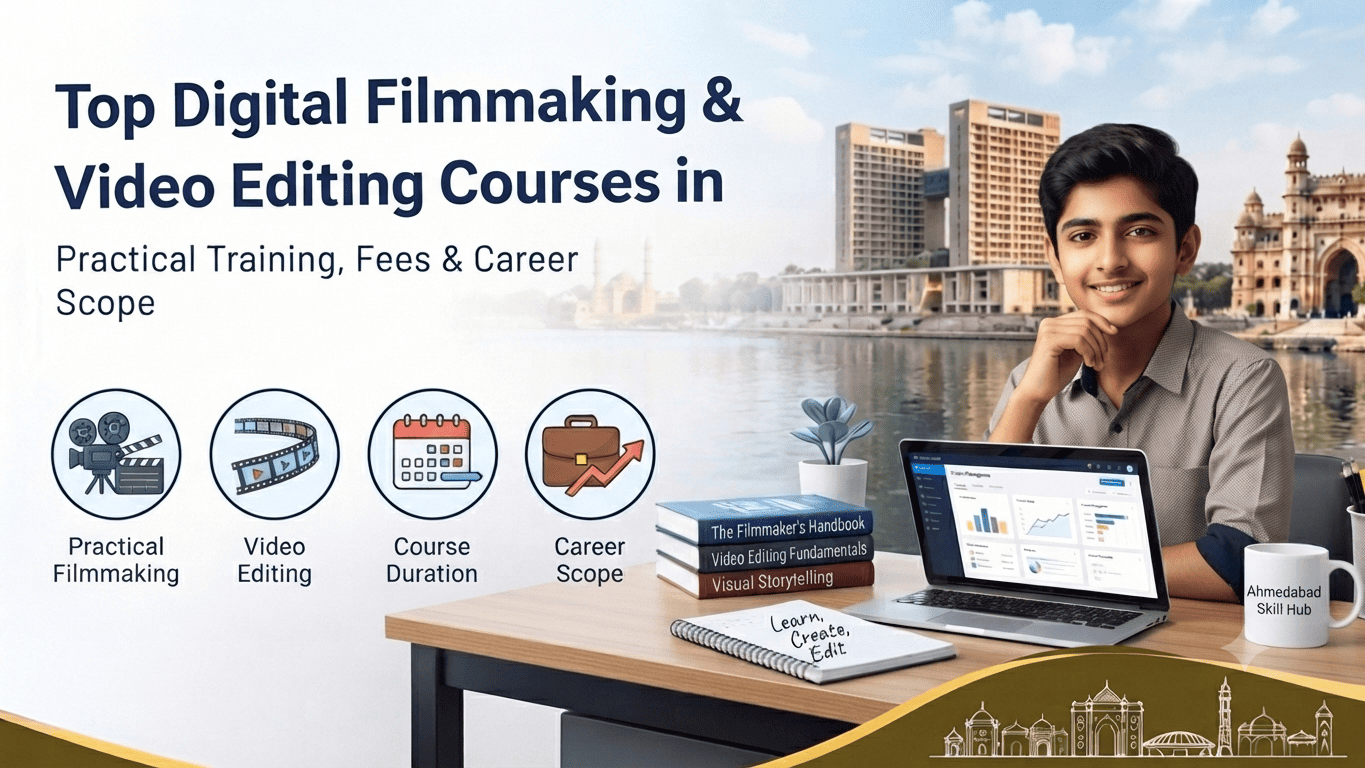
Video content has become an important part of entertainment, advertising, education, social media and digital marketing. As businesses and creators increasingly need professional videos, skilled video editors and digital filmmakers can explore a wide range of career opportunities.
The top Digital Filmmaking and Video Editing Courses in Ahmedabad can help students and beginners learn storytelling, cinematography, video editing, sound, visual effects, motion graphics and digital content production.
A practical course should go beyond software demonstrations. Learners should get opportunities to work on real projects, create a portfolio and understand the complete video-production workflow.
Introduction: Why Learn Digital Filmmaking & Video Editing in Ahmedabad?
Video is now used across almost every digital platform.
Businesses use videos for:
- Social media marketing
- Product promotion
- Brand campaigns
- Advertisements
- Corporate communication
- YouTube channels
- Educational content
- Events
- Product demonstrations
Creators use video for:
- YouTube
- Instagram Reels
- YouTube Shorts
- Online courses
- Personal brands
- Entertainment
- Freelancing
This growing demand makes digital filmmaking and video editing skills useful for students, aspiring creators, freelancers and working professionals.
Ahmedabad also has a growing ecosystem of businesses, advertising agencies, digital marketing companies, startups, production teams and content creators, creating different environments where video skills can be applied.
What Is Digital Filmmaking?
Digital filmmaking is the process of creating films and videos using modern digital production technologies.
It can include:
Concept → Script → Pre-production → Shooting → Editing → Sound → Visual Effects → Final Delivery
A digital filmmaking course may teach:
- Storytelling
- Scriptwriting
- Cinematography
- Camera operation
- Lighting
- Shot composition
- Video editing
- Sound design
- Colour correction
- Visual effects
- Motion graphics
- Digital content production
Modern courses may also introduce Artificial Intelligence and other emerging technologies.
What Is Video Editing?
Video editing is the process of selecting, arranging and enhancing video footage to create a finished story or communication piece.
A video editor may work with:
- Video clips
- Audio
- Music
- Dialogue
- Graphics
- Text
- Transitions
- Visual effects
- Colour
- Subtitles
Good editing is not simply about adding effects. It is about creating the right story, timing, flow and viewer experience.
Digital Filmmaking vs Video Editing
Although filmmaking and video editing are closely connected, they are not exactly the same.
| Digital Filmmaking | Video Editing |
|---|---|
| Covers the complete production process | Focuses mainly on post-production |
| Includes storytelling and shooting | Includes cutting and arranging footage |
| Includes cinematography | Includes timeline editing |
| Includes lighting and camera | Includes audio and visual adjustments |
| Includes production planning | Includes transitions, titles and effects |
| Broader creative workflow | More specialised post-production skill |
If you want to become a filmmaker, learning editing is highly valuable.
If you specifically want to work as an editor, you can start with a specialised video editing course.
Top Digital Filmmaking & Video Editing Course Categories in Ahmedabad
Different courses suit different career goals.
1. Digital Filmmaking Course
A comprehensive filmmaking course may cover:
- Storytelling
- Scriptwriting
- Pre-production
- Cinematography
- Camera operation
- Lighting
- Direction
- Video editing
- Sound
- Colour correction
- Visual effects
- Portfolio development
This option is suitable for students who want to understand the complete filmmaking process.
2. Professional Video Editing Course
A specialised video editing course focuses more heavily on post-production.
Common topics include:
- Editing fundamentals
- Timeline editing
- Cutting and trimming
- Transitions
- Audio editing
- Colour correction
- Titles
- Captions
- Visual effects
- Video export
- Social media formats
Students may also work on projects such as:
- YouTube videos
- Reels
- Advertisements
- Promotional videos
- Interviews
- Short films
3. Video Editing & Motion Graphics Course
Learners interested in creative post-production can combine video editing with motion graphics.
Topics may include:
- Video editing
- Typography animation
- Motion graphics
- Animated titles
- Visual effects
- Logo animation
- Social media graphics
- Promotional videos
This combination can be useful for advertising, branding and digital marketing projects.
4. Filmmaking & Video Editing Course with AI
Artificial Intelligence is becoming part of modern creative workflows.
An AI-supported filmmaking course may introduce:
- AI-assisted ideation
- Script development
- Storyboarding
- AI image generation
- AI video generation
- AI voiceover
- Subtitle generation
- AI-assisted editing
- Background modification
- Creative visualisation
AI tools can improve experimentation and productivity, but strong storytelling and editing fundamentals remain important.
5. Short-Form Video & Social Media Editing Course
Social media has created strong demand for short-form video.
Students can learn to create:
- Instagram Reels
- YouTube Shorts
- Promotional videos
- Product videos
- Educational videos
- Social advertisements
- Creator content
Important skills include:
- Fast-paced editing
- Captions
- Music synchronisation
- Vertical video
- Hook development
- Visual storytelling
- Platform-specific formats
What Is Included in a Digital Filmmaking & Video Editing Syllabus?
A comprehensive course can include the following modules.
Module 1: Storytelling Fundamentals
Students learn:
- Story structure
- Creative concepts
- Character development
- Visual storytelling
- Scene planning
Module 2: Scriptwriting
Topics may include:
- Script structure
- Screenplay basics
- Dialogue
- Scene descriptions
- Short-form scripts
- Advertisement scripts
Module 3: Pre-Production
Students learn:
- Concept development
- Script breakdown
- Shot lists
- Storyboards
- Location planning
- Production planning
Module 4: Cinematography
Topics can include:
- Camera basics
- Framing
- Composition
- Camera angles
- Camera movements
- Lighting
- Lens concepts
Module 5: Video Editing
Students learn:
- Importing footage
- Timeline editing
- Cutting
- Trimming
- Transitions
- Audio synchronisation
- Titles
- Captions
- Export settings
Module 6: Colour Correction & Grading
Students may learn:
- Colour correction
- Exposure
- White balance
- Colour consistency
- Creative grading
- Visual mood
Module 7: Sound & Audio
Topics can include:
- Dialogue editing
- Music
- Sound effects
- Audio cleanup
- Voiceovers
- Audio mixing
Module 8: Motion Graphics & VFX
Students may learn:
- Animated titles
- Motion graphics
- Basic visual effects
- Compositing
- Green-screen workflows
- Graphic animation
Module 9: Digital Content Production
Projects may include:
- YouTube videos
- Reels
- Advertisements
- Corporate videos
- Promotional videos
- Short films
Module 10: Portfolio Development
Students should ideally complete practical projects that can be presented to:
- Employers
- Production companies
- Agencies
- Clients
- Freelance platforms
Software Used in Video Editing & Filmmaking
The exact software varies between institutes and course levels.
Popular categories include:
Professional Video Editing
Software used for professional editing workflows.
Motion Graphics
Software used for animated graphics and visual effects.
Colour Grading
Specialised tools can be used for professional colour workflows.
Audio
Audio-editing software can be used for voice, dialogue, music and sound effects.
Design
Graphic-design tools can support thumbnails, titles, posters and promotional content.
AI Tools
Modern courses may also introduce AI tools for:
- Script ideas
- Visual concepts
- Image generation
- Video generation
- Voice
- Subtitles
- Editing assistance
Students should focus on learning editing principles and workflows, not just memorising software features.
Practical Training: What Should Students Actually Learn?
A good practical course should allow students to create projects instead of only watching demonstrations.
For example:
Project 1 – Social Media Reel
Create a short vertical video with:
- Hook
- Footage
- Music
- Captions
- Transitions
Project 2 – YouTube Video
Create a longer video involving:
- Editing
- Audio
- Titles
- B-roll
- Colour correction
Project 3 – Promotional Video
Create a short advertisement for a product or service.
Project 4 – Short Film
Work through:
Idea → Script → Shooting → Editing → Sound → Final Film
Project 5 – AI-Assisted Video
Create a creative video using AI-supported visual or production workflows.
These projects can become part of a student’s portfolio.
Digital Filmmaking & Video Editing Course Duration in Ahmedabad
Course duration varies according to the depth of training.
Short-Term Course
Suitable for beginners who want to learn basic video editing and digital content creation.
Certificate Course
Usually covers broader editing and filmmaking skills with practical projects.
Advanced Course
May cover:
- Professional editing
- Cinematography
- Motion graphics
- VFX
- Sound
- Colour grading
- Advanced production workflows
When comparing course duration, check the actual number of practical training hours rather than looking only at the number of months.
Video Editing & Filmmaking Course Fees in Ahmedabad
Course fees can vary considerably between institutes.
The fee may depend on:
- Course duration
- Training format
- Curriculum
- Software
- Practical sessions
- Trainer experience
- Projects
- Certification
- Portfolio support
- Career guidance
Instead of relying on a generic market price, students should ask the institute for the latest fee structure.
When comparing two courses, consider:
Fees + Practical Training + Projects + Software + Portfolio Support + Career Guidance
rather than price alone.
Online vs Classroom Video Editing Courses
Both options can work depending on your schedule.
| Feature | Classroom | Online |
|---|---|---|
| Instructor interaction | Direct | Online |
| Practical learning | Scheduled | Flexible |
| Travel | Required | Not required |
| Flexibility | Moderate | High |
| Peer interaction | Usually higher | Depends on course |
| Suitable for working professionals | Depends on timing | Often convenient |
| Learning from home | No | Yes |
If you are completely new to editing, classroom training may provide more immediate instructor interaction. Online learning can be useful for people who need flexibility.
Who Can Join a Digital Filmmaking or Video Editing Course?
These courses can be suitable for:
- Students after 10th or 12th
- College students
- Graduates
- Aspiring filmmakers
- Video editing beginners
- Content creators
- YouTubers
- Social media managers
- Digital marketers
- Graphic designers
- Freelancers
- Advertising professionals
- Working professionals
Previous professional filmmaking experience is generally not required for beginner-level courses.
Video Editing Course After 12th
Students who have completed 12th can consider video editing and filmmaking as creative career options.
A simple learning path is:
12th → Video Editing → Filmmaking Fundamentals → Practical Projects → Portfolio → Internship/Job/Freelancing
Students can also combine video editing with:
- Graphic Design
- Animation
- Motion Graphics
- Digital Marketing
- Generative AI
- UI/UX
This can create a broader creative skill set.
Career Opportunities After Video Editing & Filmmaking
After developing practical skills, learners can explore roles such as:
- Video Editor
- Assistant Video Editor
- Film Editor
- Digital Content Creator
- Video Producer
- Digital Filmmaker
- Post-Production Assistant
- Motion Graphics Artist
- Video Production Executive
- Social Media Video Editor
- YouTube Video Editor
- Content Production Executive
- Creative Content Specialist
The exact role depends on the learner’s portfolio, skills, experience and employer requirements.
Where Can Video Editors Work?
Video editing skills can be applied across multiple industries.
Potential workplaces include:
Digital Marketing Agencies
Editing promotional and social media videos.
Advertising Agencies
Creating advertisements and branded content.
Production Houses
Working on films, television or commercial productions.
Corporate Companies
Creating internal and external business videos.
Media Companies
Producing digital and editorial video content.
Educational Companies
Creating online courses and educational videos.
Startups
Producing social media and marketing content.
Freelance
Working directly with clients remotely.
Freelancing Opportunities in Video Editing
Video editing can also be developed as a freelance skill.
Freelancers can offer:
- YouTube editing
- Instagram Reel editing
- Short-form video editing
- Advertisement editing
- Corporate video editing
- Podcast editing
- Product videos
- Wedding/event editing
- Social media content
- AI-assisted video creation
However, learning software alone does not guarantee freelance work.
Successful freelancers also need:
- A strong portfolio
- Communication skills
- Client management
- Pricing knowledge
- Time management
- Consistent delivery
- Ability to understand client requirements
How to Build a Video Editing Portfolio
A portfolio is one of the most important assets for a beginner.
If you do not have professional clients yet, create your own projects.
For example:
Portfolio Project 1
A 30-second Instagram Reel.
Portfolio Project 2
A 2–3 minute YouTube video.
Portfolio Project 3
A product advertisement.
Portfolio Project 4
A before-and-after editing example.
Portfolio Project 5
A short cinematic video.
Portfolio Project 6
An AI-assisted creative video.
Present each project with:
- Project objective
- Your role
- Software used
- Editing approach
- Final result
How to Choose the Best Video Editing Course in Ahmedabad
Before joining a course, ask these questions:
1. Is the syllabus practical?
Look for assignments and projects.
2. Which software is included?
Check whether the software matches your career goal.
3. Is filmmaking included?
If you want to become a filmmaker, editing alone may not be enough.
4. Are real projects included?
Ask how many projects students complete.
5. Is portfolio development included?
Your final work should be usable for job or freelance applications.
6. Who teaches the course?
Check the trainer’s practical and professional experience.
7. Is the curriculum updated?
Digital video and AI workflows change quickly.
8. Is career assistance available?
Understand exactly what “job assistance” or “career support” means. Assistance is not automatically the same as a guaranteed job.
Digital Filmmaking + Video Editing + AI: A Modern Skill Combination
One of the strongest combinations for today’s digital-media environment is:
Filmmaking + Video Editing + AI
Each skill contributes something different.
Filmmaking
Provides storytelling and production knowledge.
Video Editing
Provides post-production and storytelling through editing.
AI
Provides additional tools for ideation, visualisation and production efficiency.
This combination can be useful for creators working in:
- Advertising
- Social media
- Digital marketing
- Content production
- Video production
- Creative agencies
- Freelancing
Digital Filmmaking Career Roadmap for Beginners
A beginner can follow this step-by-step path:
Step 1 – Learn Storytelling
Understand how stories and visual communication work.
Step 2 – Learn Video Editing
Start with cuts, pacing, audio, transitions and basic colour correction.
Step 3 – Learn Filmmaking
Study camera, lighting, composition and production.
Step 4 – Learn Motion Graphics
Add titles, animation and visual effects.
Step 5 – Explore AI
Learn AI-assisted workflows for ideas, visuals, audio and video.
Step 6 – Create Projects
Build multiple practical videos.
Step 7 – Build a Portfolio
Show your best work professionally.
Step 8 – Start Applying
Explore:
Internships → Jobs → Freelancing → Content Creation
Quick Answer: Which Course Should You Choose?
| Career Goal | Recommended Course |
|---|---|
| Become a Video Editor | Video Editing Course |
| Become a Filmmaker | Digital Filmmaking Course |
| Create YouTube Videos | Video Editing + Content Creation |
| Create Reels | Short-Form Video Editing |
| Work in Advertising | Filmmaking + Editing + Motion Graphics |
| Work in Digital Marketing | Video Editing + Digital Marketing |
| Become a Creative Freelancer | Video Editing + Motion Graphics + AI |
| Explore Modern Video Production | Filmmaking + Editing + AI |
Frequently Asked Questions (FAQs)
1. Which is the best Digital Filmmaking and Video Editing Course in Ahmedabad?
The best course depends on your career goal. Look for a program that offers practical filmmaking, professional video editing, project work, portfolio development and updated digital-media skills.
2. What is taught in a Video Editing Course in Ahmedabad?
A comprehensive course may teach video editing, timeline management, cutting, transitions, audio, colour correction, titles, captions, visual effects, motion graphics and export formats.
3. Can I learn video editing after 12th?
Yes. Students can begin with a beginner-level video editing course and gradually learn filmmaking, motion graphics, AI and other creative skills.
4. How much do video editing courses cost in Ahmedabad?
Fees vary depending on the institute, duration, software, curriculum, practical training and other services. Always check the latest fee structure directly with the institute.
5. How long does a video editing course take?
It depends on the course. Short-term programs may teach basic editing, while comprehensive programs can cover filmmaking, editing, motion graphics, VFX and advanced production.
6. Is video editing a good career option?
Video editing can be a useful career skill because video is used extensively in entertainment, advertising, social media, education, marketing and business communication.
7. Can I get a job after completing a video editing course?
A course can help you develop relevant skills, but employment depends on your portfolio, practical ability, communication, experience and employer requirements.
8. Can I freelance as a video editor?
Yes. Freelance services can include YouTube editing, Reels, advertisements, corporate videos, social media content and other video-production work.
9. Do I need a professional camera to learn filmmaking?
Not necessarily. Beginners can learn storytelling, composition and editing using available equipment before progressing to professional camera and production workflows.
10. Should I learn AI along with video editing?
AI can be a useful additional skill for modern video creators. However, it is best learned alongside fundamental editing, storytelling and filmmaking skills.
Conclusion
Choosing a Digital Filmmaking and Video Editing Course in Ahmedabad can be a valuable step for students, aspiring filmmakers, content creators and professionals who want to enter the digital-media industry.
A good course should provide more than software training. It should teach storytelling, cinematography, editing, sound, colour, motion graphics, practical production and portfolio development.
Modern learners can also add AI-assisted filmmaking and video-production skills to their existing knowledge.
The ideal learning path is:
Storytelling → Video Editing → Filmmaking → Motion Graphics → AI Tools → Practical Projects → Portfolio → Career
Before enrolling, compare the syllabus, practical training, course duration, fees, software, projects, trainer experience and career support.
With consistent practice and a strong portfolio, digital filmmaking and video editing can open opportunities across production houses, advertising agencies, digital marketing companies, media organisations, businesses, social media teams and freelance work.